Beyond Absolute Certainty and Total Relativism
A Franciscan Path Through Modern Confusion
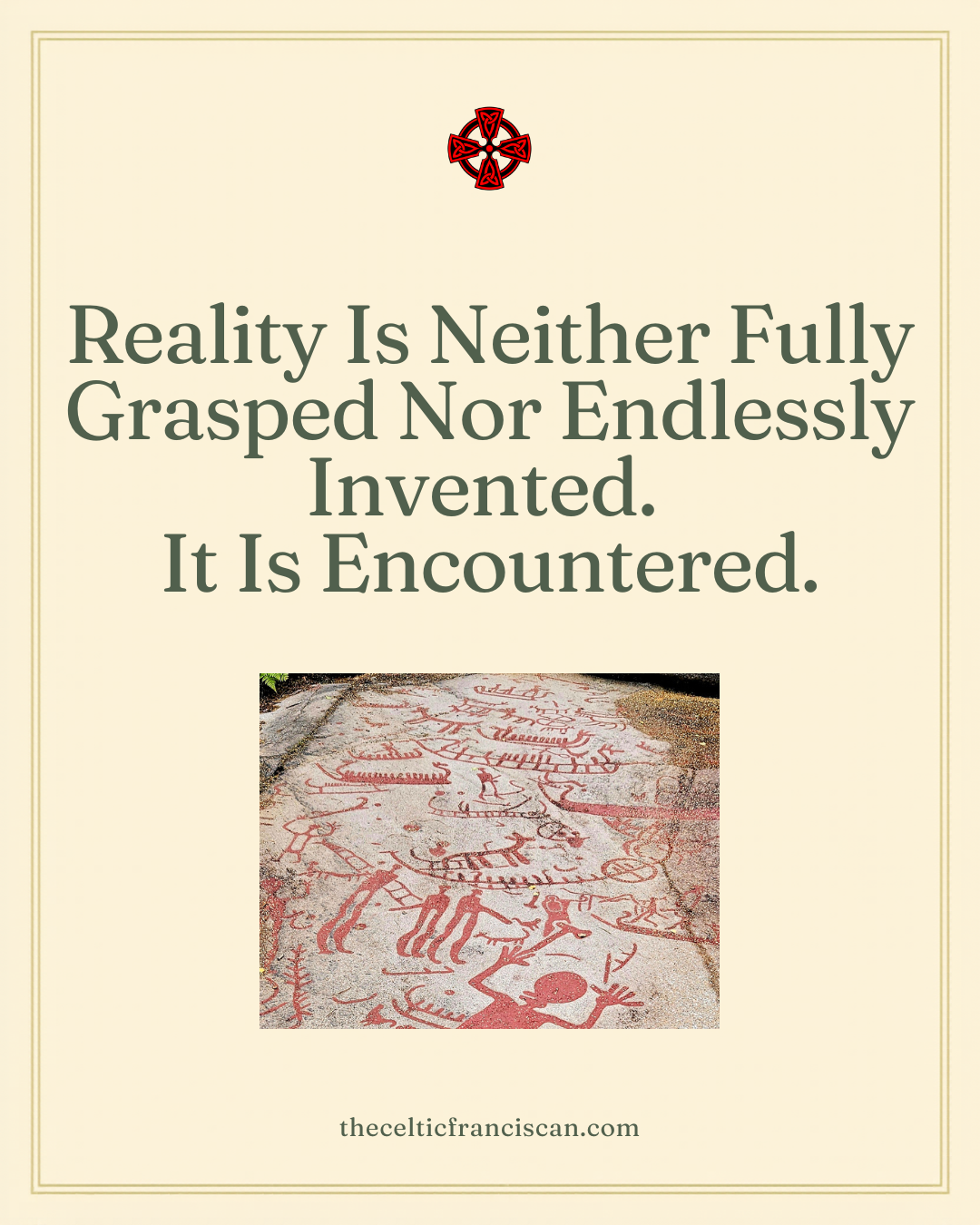
Reality is neither fully grasped nor endlessly invented. It is encountered.
That sentence may be one of the most needed spiritual corrections in our age of confusion.
Modernity often claimed too much certainty. It wanted reality measurable, manageable, systematized, categorized, explained, and controlled. It gave us extraordinary gifts: science, medicine, engineering, democracy, technology, and the ability to ask hard questions without immediately being burned at the stake, which I personally count as progress.
But modernity also had a shadow.
It tempted us to believe that if something could not be measured, it was not real. If something could not be proven, it was not meaningful. If something could not be controlled, it was not trustworthy. Mystery became a problem. Wonder became childish. Reverence became inefficient. The world became an object, and human beings became observers, managers, users, and consumers.
Then postmodernity arrived, looked at all that confidence, and said, “Are you sure?”
And it was right to ask.
Postmodernity exposed the arrogance hidden inside many claims of objectivity. It noticed that power often dresses itself up as truth. It reminded us that every person sees through culture, language, history, trauma, desire, class, race, gender, and location. It warned us that no one gets a clean, viewless view from nowhere.
Again, this was not all bad. Some idols needed smashing. Some certainties were not truth at all, but privilege with a podium.
But postmodernity also has a shadow.
If modernity tried to conquer reality with certainty, postmodernity sometimes dissolves reality into endless interpretation. Everything becomes perspective. Everything becomes language. Everything becomes power. Everything becomes personal construction. The ground gives way beneath us, and what first felt like liberation can become exhaustion.
When nothing is certain, we may become humble.
But when nothing is trustworthy, we become lost.
The Two Temptations
Modern people are caught between two temptations.
The first temptation is rigid certainty.
This is the voice that says, “I see reality exactly as it is. My group is right. My system is complete. My language is pure. My conclusions are final. Anyone who disagrees is ignorant, dangerous, or morally defective.”
This is certainty as control.
It does not produce wisdom. It produces arrogance.
The second temptation is total relativism.
This is the voice that says, “There is no truth, only interpretation. There is no meaning, only construction. There is no goodness, only preference. There is no reality, only competing stories.”
This is uncertainty as despair.
It does not produce freedom. It produces fragmentation.
The Franciscan path refuses both.
It refuses the arrogance that says reality can be fully possessed by the intellect.
It also refuses the despair that says reality is nothing more than whatever the ego, tribe, algorithm, or institution declares it to be.
Reality is neither fully grasped nor endlessly invented.
It is encountered.
Encounter Is Different Than Control
To encounter reality is to meet it.
Not dominate it.
Not consume it.
Not reduce it.
Not invent it.
Not weaponize it.
Not escape it.
Meet it.
This is a deeply Franciscan way of seeing.
Francis of Assisi did not encounter creation as a set of objects to classify or exploit. He encountered kin: Brother Sun, Sister Moon, Brother Fire, Sister Water. To modern ears, that may sound poetic, perhaps even quaint. But Francis was not being cute. He was seeing differently.
He saw relationship where others saw resource.
He saw gift where others saw possession.
He saw presence where others saw matter.
He saw God shining through the ordinary.
Francis did not need to conquer reality in order to trust it. He did not need to explain everything in order to love it. He did not need to possess creation in order to belong within it.
That is the humility of encounter.
The Answer to Failed Certainty Is Not Despair
The answer to failed certainty is not despair. It is deeper humility.
That distinction matters.
Humility does not mean pretending we know nothing. It means remembering that whatever we know, we know partially. We see through lenses. We interpret through experience. We perceive through wounds and loves, fears and hopes, language and memory.
Humility keeps knowledge human.
It allows us to say:
“I may be wrong.”
“I may not see the whole.”
“My experience is real, but not total.”
“My interpretation may need conversion.”
“My certainty may be protecting something in me that needs healing.”
This kind of humility is not weakness. It is spiritual maturity.
Rigid certainty cannot repent because it cannot imagine itself wrong.
Total relativism cannot repent because it has lost confidence that anything is truly good.
Humility can repent.
Humility can listen.
Humility can learn.
Humility can encounter.
Reality Is Participatory
A Franciscan path does not treat reality as dead material waiting for human control. Nor does it treat reality as a blank screen for human projection.
Reality is participatory.
We are not detached observers floating above the world. We are embodied creatures within creation. We breathe the same air. We share the same soil. We receive the same light. We suffer, love, eat, grieve, forgive, hope, and die within the same mystery.
We do not stand outside reality looking in.
We belong to it.
And because we belong to it, we come to know reality not only by analysis but by participation.
You do not truly know music by studying sound waves alone. You must listen.
You do not truly know bread by analyzing carbohydrates alone. You must taste.
You do not truly know grief by defining bereavement alone. You must love someone enough to miss them.
You do not truly know God by collecting doctrines alone. You must be drawn into love.
This does not make analysis useless. Far from it. Reason is a gift. Science is a gift. Language is a gift. Doctrine is a gift. But gifts become idols when they forget what they serve.
Reason serves wisdom.
Science serves wonder.
Language serves encounter.
Doctrine serves love.
AI and the Crisis of Knowing
This matters urgently in the age of artificial intelligence.
AI is extraordinarily skilled at manipulating language, identifying patterns, generating summaries, simulating style, and producing plausible answers. It can give us more information than we know what to do with. It can argue many sides of many questions. It can imitate certainty and manufacture confidence.
But wisdom is not the same as information.
And reality is not the same as content.
The danger of AI is not simply that machines may become more powerful. The deeper danger is that we may become more confused about what knowing actually is.
We may mistake quick answers for understanding.
We may mistake generated language for wisdom.
We may mistake simulation for encounter.
We may mistake data about people for relationship with people.
We may mistake prediction for truth.
A Franciscan response to AI must therefore be more than technical ethics. It must be spiritual formation.
What kind of people are we becoming?
Are we becoming more attentive?
More humble?
More loving?
More capable of silence?
More able to bear ambiguity?
More rooted in community?
More willing to encounter the real?
Or are we becoming faster, louder, thinner, more reactive, and more easily programmed?
The Practice of Encounter
Encounter requires practice.
It requires slowing down long enough to let reality speak before we label it.
It requires listening to another person without immediately converting them into a category.
It requires walking outside without turning creation into background scenery for our private thoughts.
It requires prayer that is not merely asking God to endorse our agenda.
It requires silence that lets our own noise settle.
It requires reverence.
Reverence is how humility behaves in the presence of mystery.
It says:
“This person is more than my opinion of them.”
“This tree is more than an object.”
“This moment is more than a task.”
“This suffering is more than an inconvenience.”
“This body is more than a machine.”
“This world is more than data.”
“This life is more than production.”
Reverence protects reality from being flattened by the ego.
A Third Way Through Confusion
So what do we do in an age caught between absolute certainty and total relativism?
We practice a third way.
Not certainty as domination.
Not uncertainty as despair.
But humility as encounter.
We hold our beliefs with conviction, but not violence.
We honor reason, but do not worship it.
We listen to experience, but do not absolutize it.
We trust tradition, but do not fossilize it.
We use technology, but do not let it define us.
We seek truth, but remember that Truth is not finally a possession. Truth is a Person who invites us into love.
That is why the Christian path is not merely about being right. It is about being transformed.
It is about learning to see.
And perhaps this is where Francis still has something to teach the age of algorithms.
Take off your shoes.
Touch the earth.
Look at the face in front of you.
Listen before speaking.
Let the world become gift again.
Let mystery humble you without humiliating you.
Let love teach you what certainty cannot.
Reality is neither fully grasped nor endlessly invented.
It is encountered.
And the encounter begins here, now, in the sacred ordinary, where God is always arriving disguised as what is real.