From Mechanism to Meaning
Why the World Is More Than Data
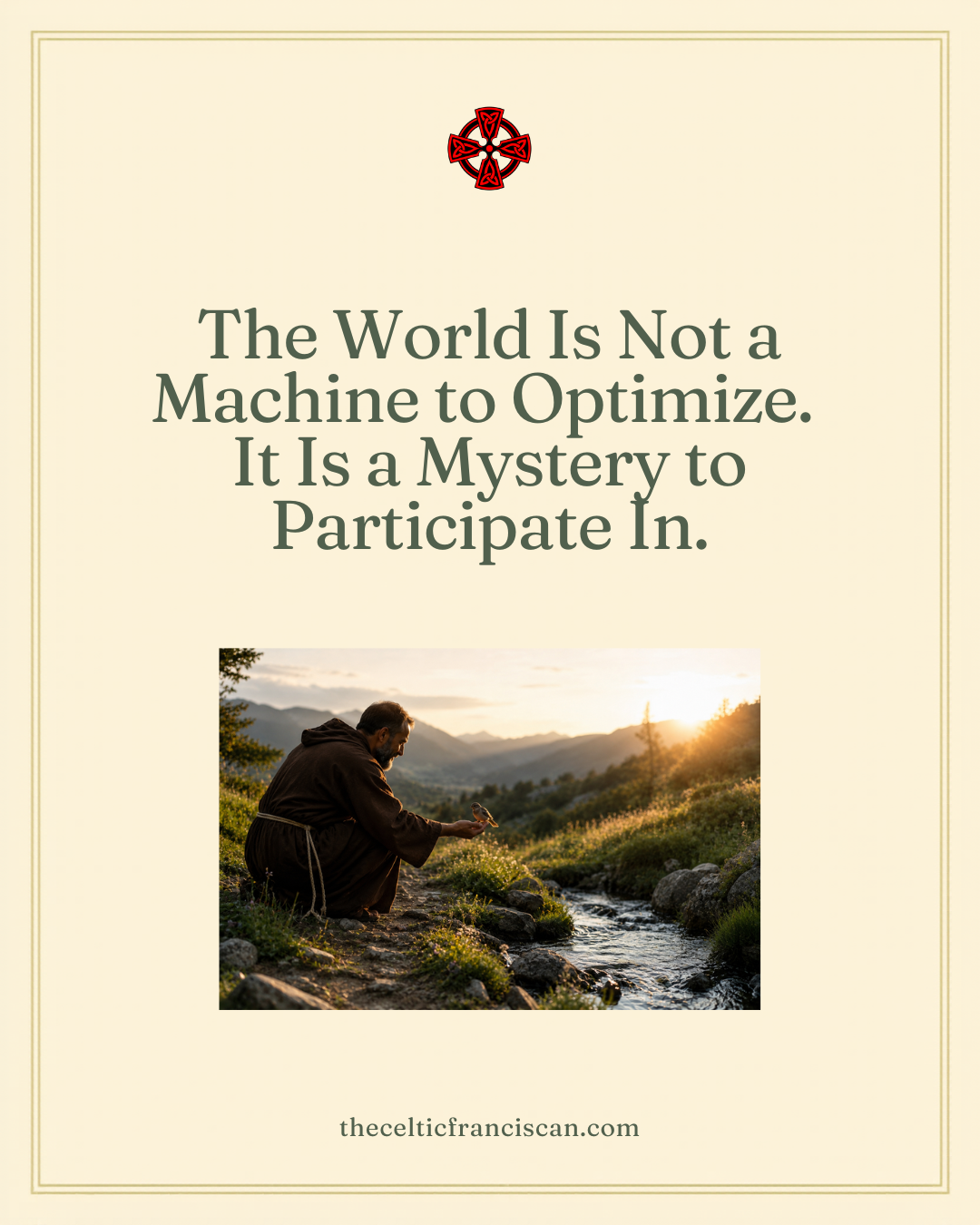
The world is not a machine to optimize. It is a mystery to participate in.
That may be the simplest way to name the spiritual task before us.
We live in an age that has become very good at optimization. We optimize calendars, supply chains, workflows, sleep cycles, marketing funnels, calorie intake, productivity, attention, and even relationships. We measure, track, categorize, compare, automate, and improve.
Some of this is useful. I am not against efficiency. A disorganized monastery still has to find the coffee.
But something happens to the soul when optimization becomes our primary way of seeing.
The world becomes a system.
Creation becomes raw material.
People become data points.
Community becomes network traffic.
Friendship becomes engagement.
Wisdom becomes content.
Spirituality becomes self-improvement.
And love becomes something dangerously close to emotional productivity.
That is not a small problem.
It is a metaphysical one.
From Enchanted Cosmos to Machine
For much of human history, the world was experienced as enchanted. Not necessarily magical in the cheap sense, but meaningful. The heavens, rivers, forests, animals, seasons, birth, death, bread, wine, fire, silence, and song all participated in a larger sacred order.
The world spoke.
Creation was not merely stuff. It was sign, gift, presence, and participation.
Then modernity gave us the machine.
Again, this brought many gifts. Science, medicine, engineering, sanitation, transportation, and technology have relieved enormous suffering. I have no interest in pretending the past was one long Celtic harp solo in a misty field. History had fleas, famine, and questionable dentistry.
But the machine also reshaped our imagination.
Nature became mechanism.
The body became mechanism.
Society became mechanism.
Work became mechanism.
Even the human mind began to be imagined as a kind of mechanism.
If something could be measured, it mattered.
If something could be controlled, it was useful.
If something could be predicted, it was valuable.
Mystery became suspect.
Wonder became inefficient.
Reverence became optional.
From Machine to Data
Then came the digital age.
The machine became data.
The world was no longer merely mechanism. It was information. Everything could be translated into signals, patterns, metrics, behaviors, clicks, preferences, profiles, probabilities, and predictions.
We became readable.
Our habits could be tracked.
Our desires could be inferred.
Our attention could be monetized.
Our relationships could be mapped.
Our emotions could be nudged.
Our identities could be packaged.
This did not happen all at once. It happened gently, conveniently, and with excellent user experience design.
We were not conquered by machines with red laser eyes. We were seduced by convenience.
Now we inhabit a world where almost everything can become content, and almost everyone can become a user.
But a person is not a user.
A person is a mystery.
From Data to Simulation
Artificial intelligence accelerates the next turn.
The world is no longer only enchanted, mechanized, or digitized. It is increasingly simulated.
AI can simulate conversation.
It can simulate empathy.
It can simulate creativity.
It can simulate spiritual reflection.
It can simulate friendship, coaching, companionship, and care.
Sometimes these tools are helpful. Sometimes profoundly so.
But simulation is not the same as participation.
A map is not a forest.
A recipe is not a meal.
A profile is not a person.
A chatbot is not communion.
A generated prayer is not surrender.
A simulated relationship is not love.
Technology can optimize systems, but only love can redeem relationships.
That distinction may save us.
Reality Is Sacramental
The Celtic Franciscan vision begins somewhere else.
Reality is sacramental.
That does not mean everything is obviously religious. It means the visible world can disclose invisible grace. It means matter matters. It means the ordinary is capable of bearing glory.
Bread can become communion.
Water can become baptism.
A table can become hospitality.
A wound can become mercy.
A stranger can become Christ.
A forest can become cathedral.
A conversation can become prayer.
A moment can become revelation.
The world is not merely an object before us.
It is a mystery we are inside of.
Francis of Assisi understood this in his bones. He did not walk through creation as a manager of resources. He encountered Brother Sun, Sister Moon, Brother Fire, Sister Water, Sister Mother Earth.
This was not sentimental nature poetry. It was a different mode of perception.
Francis saw kinship where others saw utility.
He saw gift where others saw possession.
He saw presence where others saw material.
He saw relationship where others saw objects.
That is sacramental vision.
And we desperately need it now.
Participation Is Not Passivity
To say the world is a mystery to participate in does not mean we stop acting.
Franciscan spirituality is not an excuse for dreamy inaction. Francis rebuilt churches, embraced lepers, challenged wealth, gathered community, preached peace, and lived a life of radical embodied response.
Participation is not passivity.
It is action flowing from belonging.
That matters.
When we see the world as a machine, we act as operators.
When we see the world as data, we act as analysts.
When we see the world as market, we act as consumers.
When we see the world as sacrament, we act as lovers.
And lovers behave differently.
They listen.
They tend.
They protect.
They forgive.
They repair.
They notice.
They give thanks.
They refuse to reduce the beloved to usefulness.
A lover does not look at a tree and see only lumber.
A lover does not look at a river and see only water rights.
A lover does not look at a child and see only future productivity.
A lover does not look at a neighbor and see only ideology.
A lover does not look at the poor and see only a policy problem.
A lover does not look at the earth and see only extractable value.
Love restores the face of the world.
The AI Age Needs More Than Ethics
We often talk about AI ethics, and rightly so. We need guardrails, transparency, accountability, privacy, fairness, security, and wise governance.
But ethics without spiritual formation will not be enough.
Why?
Because tools reveal desires.
AI will not merely show us what machines can do. It will reveal what humans want. And much of what we want is speed, control, profit, convenience, attention, stimulation, status, and the removal of friction.
The real question is not only, “What can AI do?”
The deeper question is, “What kind of people are we becoming as we build and use it?”
Are we becoming more present?
More loving?
More humble?
More patient?
More truthful?
More communal?
More reverent?
More capable of silence?
Or are we becoming faster, thinner, louder, lonelier, and more easily manipulated?
The crisis of AI is not only technological.
It is spiritual.
Optimization Has Its Place
Let us be fair.
Optimization is not evil.
Hospitals should optimize patient care.
Food systems should optimize distribution.
Nonprofits should optimize resources.
Businesses should optimize wasteful processes.
Families should optimize calendars enough to remember soccer practice, dental appointments, and the mysterious school event that appears with twelve hours’ notice.
Good order can serve love.
But optimization becomes destructive when it forgets what it serves.
Efficiency is a servant, not a savior.
When efficiency serves love, it can be holy.
When love is sacrificed to efficiency, something human dies.
That is true in business.
It is true in ministry.
It is true in education.
It is true in technology.
It is true in the soul.
The goal of life is not maximum output.
The goal is communion with God, neighbor, creation, and the deepest truth of who we are.
Recovering Meaning
So how do we recover meaning in an age of mechanism, data, and simulation?
We begin by practicing participation.
Eat slowly enough to taste.
Walk slowly enough to notice.
Listen long enough to be changed.
Pray without turning prayer into a productivity tool.
Look at creation without immediately using it.
Speak to people without reducing them to positions.
Use technology without letting it name you.
Serve without needing applause.
Rest without guilt.
Give thanks before you understand.
This is not complicated.
It is difficult.
Because participation asks us to surrender the illusion of control.
It asks us to belong before we manage.
It asks us to receive before we produce.
It asks us to love before we optimize.
The Mystery We Are In
The world is not a machine to optimize.
It is not merely data to analyze.
It is not merely content to consume.
It is not merely simulation to manipulate.
It is a mystery to participate in.
And this mystery is not vague. It has a shape.
It looks like bread broken and shared.
It looks like water poured in blessing.
It looks like creation received as kin.
It looks like enemies forgiven.
It looks like the poor honored.
It looks like silence deepening into prayer.
It looks like technology humbled into service.
It looks like love taking flesh.
The world does not need us to become less intelligent.
It needs us to become more reverent.
It does not need us to abandon technology.
It needs us to remember what technology is for.
It does not need more simulation of connection.
It needs communion.
Technology can optimize systems.
But only love can redeem relationships.
And the soul knows the difference.