
The Machine Cannot Wonder
Why Descartes Still Shapes the AI Age
The machine analyzes. The soul wonders.
That may be one of the simplest ways to name the spiritual crisis of our age.
Artificial intelligence did not appear from nowhere. It arrived as the child of a long philosophical inheritance. Long before we built machines that could imitate conversation, generate images, summarize books, predict behavior, and simulate empathy, we first learned to imagine the world itself as a machine.
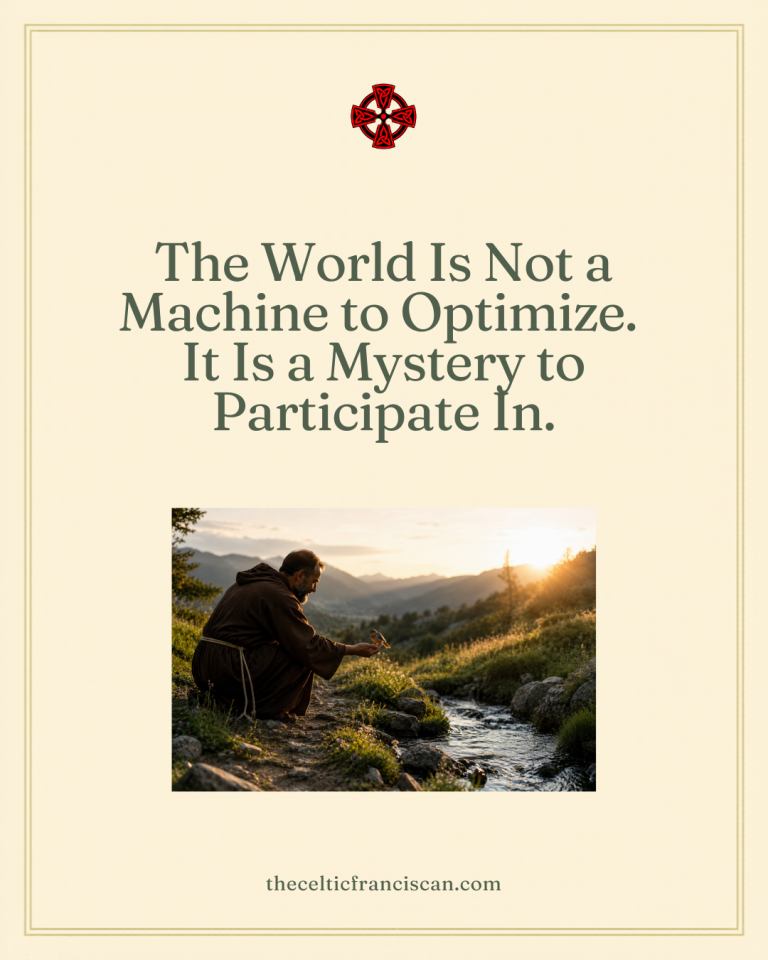
René Descartes helped give modernity one of its most powerful images: nature as an intricate, impersonal mechanism governed by mathematical and mechanical law. In that vision, the world became something to measure, predict, control, and optimize. The cosmos was no longer primarily a living mystery to participate in, but a system to be decoded.
That way of seeing gave us many gifts. Science, medicine, engineering, computing, and modern technology have relieved enormous suffering and expanded human possibility. I am not interested in pretending otherwise. A Franciscan with Wi-Fi should avoid romantic nonsense before breakfast.
But every worldview has consequences.
If the world is only a machine, then nature becomes raw material.
If the body is only a machine, then health becomes maintenance.
If the mind is only a machine, then thought becomes computation.
If relationships are only exchanges of signals, then love becomes data.
If humanity is only a predictable organism, then personhood becomes a pattern.
And eventually, a world reduced to mechanism reduces human beings to functions.
AI and the Inheritance of Mechanism
Artificial intelligence inherits this mechanical imagination. It is built on pattern recognition, prediction, classification, and optimization. It analyzes language. It detects correlations. It imitates tone. It can generate astonishingly human-sounding responses.
But it does not wonder.
AI can process a poem, but it cannot ache under the weight of beauty.
It can describe grief, but it cannot lose a father.
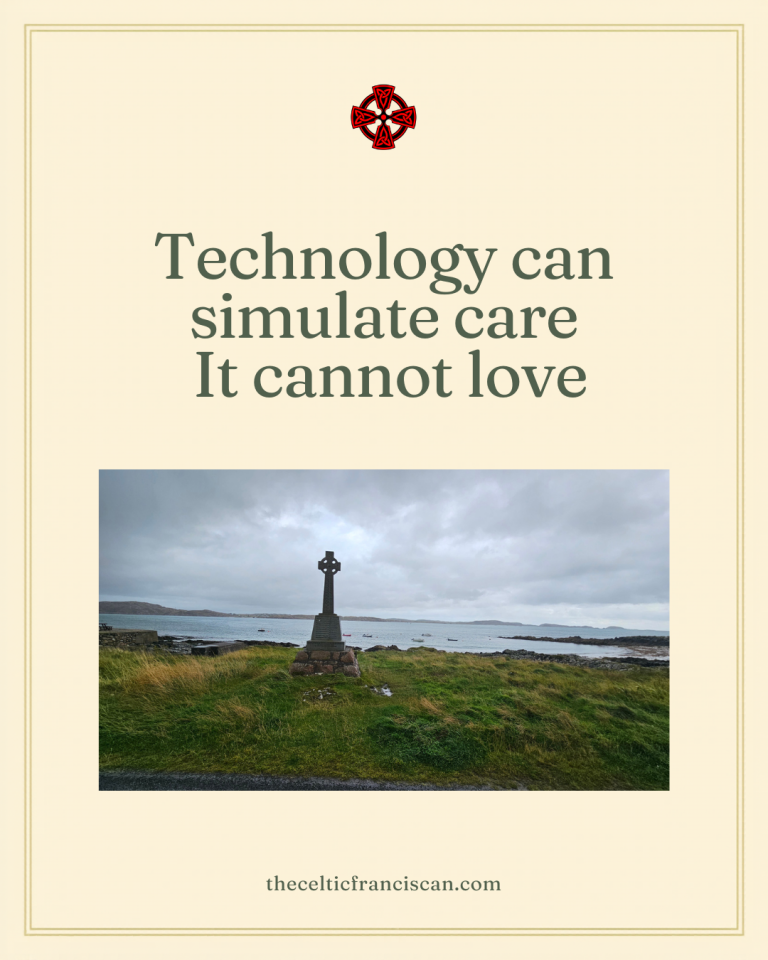
It can simulate compassion, but it cannot suffer with you.
It can generate a prayer, but it cannot kneel.
It can recommend forgiveness, but it cannot forgive.
It can speak of hope, but it cannot hope.
This distinction matters more than we think.
The danger is not that machines can perform tasks once reserved for humans. The danger is that we may slowly accept the machine’s way of seeing as the final truth about ourselves.
We may begin to believe that because love can be described, it can be replaced.
Because empathy can be imitated, it can be outsourced.
Because wisdom can be summarized, it can be automated.
Because prayer can be generated, it can be simulated.
But the soul is not a software feature.
What Mechanism Cannot Hold
Awe, grief, love, beauty, prayer, moral conscience, and wonder do not fit easily into a mechanical worldview. They are not reducible to inputs and outputs. They are not merely biological noise surrounding useful cognition. They are not inefficient leftovers from a pre-scientific age.
They are among the deepest signs of being human.
Awe tells us reality is larger than our concepts.
Grief tells us love has touched us deeply enough to wound us.
Beauty tells us the world is not merely useful.
Prayer tells us we are addressed by mystery.
Conscience tells us truth is not simply what benefits us.
Love tells us another person is not an object.
These are not bugs in the human system. They are windows.
The Franciscan tradition has always resisted reducing the world to mechanism. Francis of Assisi did not encounter creation as a collection of objects. He encountered brother sun, sister moon, brother fire, sister water. This was not childish poetry. It was spiritual perception.
Francis saw relationship where others saw resource.
He saw kinship where others saw category.
He saw gift where others saw possession.
He saw God shining through the ordinary.
That is not anti-science. It is anti-reduction.
The Machine Can Help. It Cannot Behold.
The answer is not to reject technology. Technology can serve love. It can extend care, support communication, reduce burdens, improve access, and help us do meaningful work. The question is not whether we use machines.
The question is whether we let machines define what a human being is.
There is a difference between using AI as a tool and accepting AI as an anthropology. A tool helps us act. An anthropology tells us who we are.
If we accept the machine’s vision of reality, then we will increasingly measure ourselves by machine values: speed, efficiency, productivity, predictability, scalability, and output.
But the most human things are often slow.
Healing is slow.
Trust is slow.
Friendship is slow.
Grief is slow.
Wisdom is slow.
Prayer is slow.
Community is slow.
Love is slow.
Perhaps that is why they are so easily dismissed in an age obsessed with acceleration.
Wonder as Resistance
Wonder may be one of the most necessary spiritual practices of the AI age.
Wonder interrupts consumption.
Wonder interrupts certainty.
Wonder interrupts cynicism.
Wonder interrupts the illusion that reality exists only to be used.
To wonder is to stand before the world without immediately trying to control it. It is to let a tree be more than lumber, a river more than water supply, a person more than a profile, a child more than future productivity, and a soul more than a psychological mechanism.
Wonder is not ignorance. Wonder is reverent intelligence.
It is the mind bowing before mystery without surrendering thought. It is reason discovering its proper posture. It is knowledge becoming humble enough to become wisdom.
The machine analyzes. The soul wonders.
Both have their place. But only one can love.
Remaining Human
The great challenge of the AI age is not whether machines will become more humanlike. They will.
The deeper question is whether humans will become more machinelike.
Will we allow ourselves to be trained by systems that reward speed over depth, reaction over reflection, simulation over communion, and efficiency over love?
Or will we recover practices that keep us human?
Silence.
Prayer.
Embodied presence.
Shared meals.
Gratitude.
Sabbath.
Forgiveness.
Contemplation.
Attention to creation.
Service to the poor.
Actual conversation with actual people in actual rooms.
The future does not need less intelligence. It needs more wisdom.
It does not need less technology. It needs technology placed in service of human flourishing.
It does not need artificial intimacy. It needs embodied love.
So yes, let the machine analyze. Let it calculate, organize, assist, and automate where it can.
But let the soul wonder.
Because a world without wonder may still function.
It just will not be fully alive.