You Are Valuable Because You Are
Modern culture has a habit of turning human beings into machinery.
We ask children what they want to do before we ask who they are becoming.
We measure worth by productivity, visibility, achievement, efficiency, and output.
We glorify exhaustion and call it ambition.
We confuse busyness with meaning.
And eventually, many people quietly begin believing a dangerous lie:
“If I stop producing, I stop mattering.”
But the soul cannot survive long under transactional love.
You were never meant to earn your humanity.
Franciscan spirituality begins somewhere radically different. Before you achieve, succeed, perform, fix, optimize, or prove anything — you are already beloved. Your existence itself carries dignity because you are created in the image of God.
Not because you are useful.
Not because you are successful.
Not because you are impressive.
Because you are.
This becomes difficult to remember in a world increasingly shaped by metrics and algorithms. Social media counts attention. Corporations count productivity. AI systems quantify behavior. Even relationships can begin feeling transactional if we are not careful.
But love does not operate by efficiency.
A parent does not love a child because the child produces value. A friend does not sit beside you in grief because it improves quarterly outcomes. Sacred presence cannot be reduced to utility.
The Incarnation itself reveals this truth. God did not become human to optimize humanity. God became human to dwell with humanity.
To be with.
That changes everything.
Contemplation teaches us to rediscover being beneath all the noise of doing. As I’ve written elsewhere, contemplation is “awareness filled with love” and the practice of being with rather than doing for.
The deeper spiritual life becomes, the more we realize that identity grounded in performance always creates fear. Fear of failure. Fear of irrelevance. Fear of slowing down. Fear that without constant achievement we may disappear.
But God does not relate to us as a résumé.
The mystics understood this deeply. They spoke of the false self — the constructed identity built from approval, achievement, status, comparison, and control. Beneath that false self is something quieter and truer: the soul held in divine love before it ever accomplished anything.
This is why burnout is not only physical exhaustion. Often it is spiritual exhaustion from trying to justify our existence.
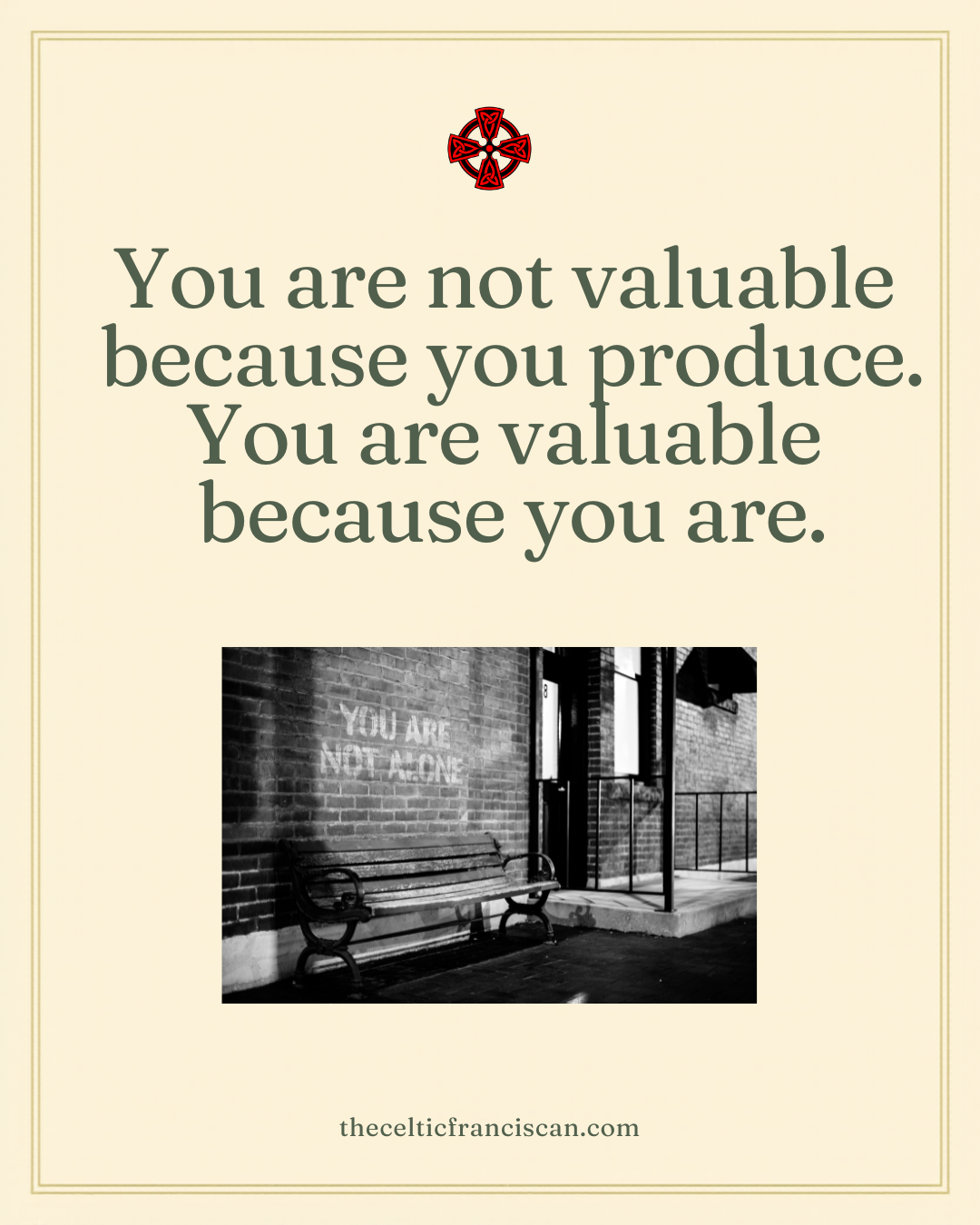
The image above says something many people desperately need to hear:
You are not alone.
And you do not have to perform your way into worthiness.
The sacred invitation is not endless striving.
It is surrender into belovedness.
Ironically, when we stop grounding our identity in productivity, our work often becomes healthier, freer, and more compassionate. Doing begins to flow from being rather than anxiety. Service becomes an expression of love instead of self-protection.
You are not valuable because you produce.
You are valuable because you are.
And nothing — not failure, weakness, unemployment, aging, illness, grief, or imperfection — can erase the dignity of a soul loved by God.
Practice: Recover Your Being
Today, intentionally resist the temptation to measure your worth by productivity.
- Sit quietly for ten minutes without trying to accomplish anything.
- Place your hand over your heart and breathe slowly.
- Repeat gently: “I do not have to earn my belovedness.”
- Take a walk without tracking steps, goals, or outcomes.
- Spend time with someone simply to be present, not productive.
- Notice moments where you define yourself by achievement or failure.
- Ask yourself: “Who am I when I stop performing?”
Let your doing flow from your being — not your fear.