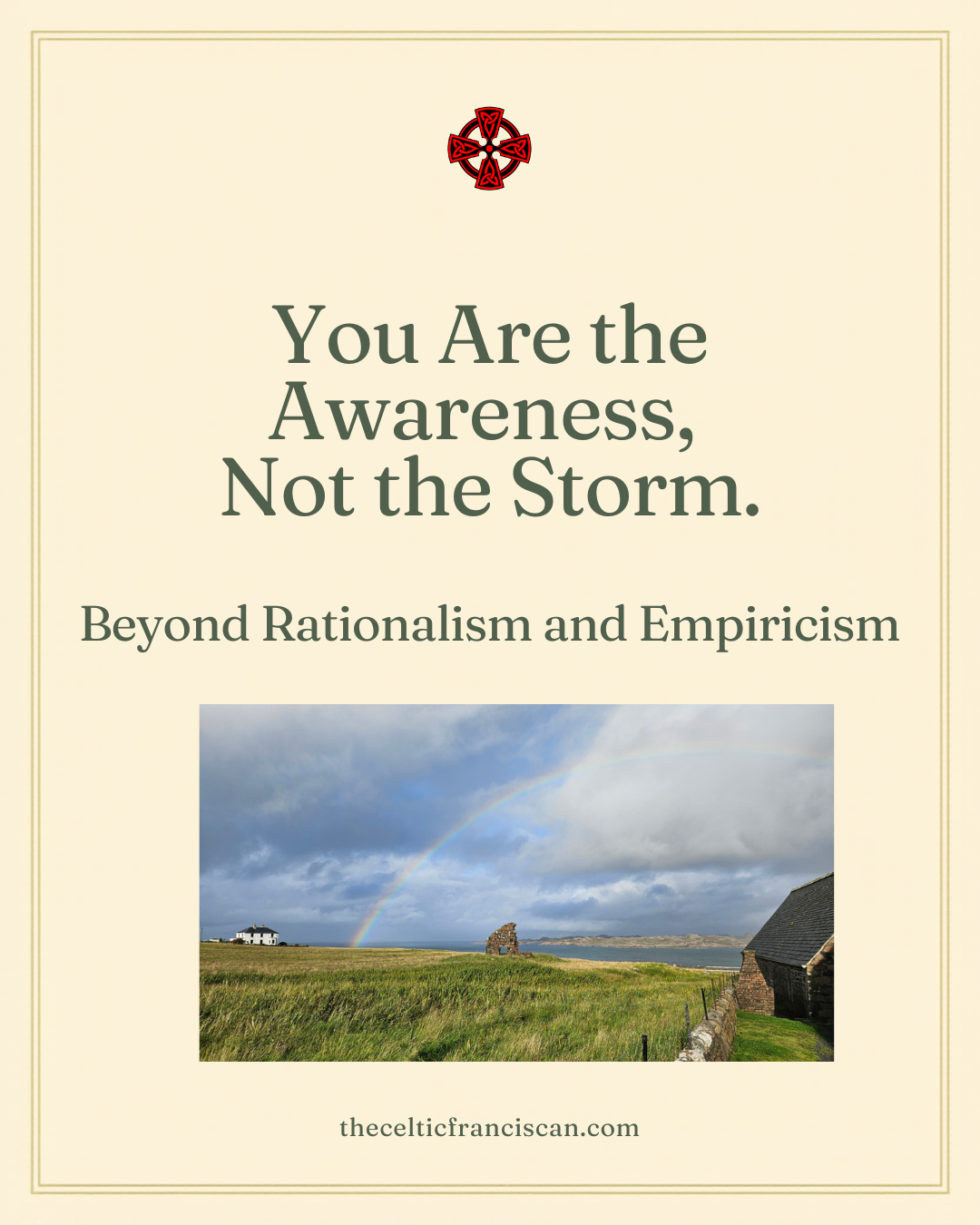
You Are the Awareness, Not the Storm.
Beyond Rationalism and Empiricism
For centuries, Western thought has wrestled with two great approaches to truth:
Rationalism says truth is discovered through reason.
Empiricism says truth is discovered through experience.
One trusts the mind.
The other trusts the senses.
One asks:
“What can I logically know?”
The other asks:
“What can I directly observe?”
And honestly, both matter.
Reason protects us from illusion, superstition, and chaos. Experience protects us from abstraction detached from real life. We need science. We need philosophy. We need evidence. We need critical thinking.
But somewhere along the way, many of us became trapped inside a false choice.
Mind versus body.
Thought versus feeling.
Faith versus reason.
Science versus spirituality.
Objectivity versus subjectivity.
The contemplative traditions have always pointed toward a deeper integration.
Not either/or.
Both/and.
The goal is not clinging to opposing worldviews.
The goal is wholeness.
As Boethius wrote centuries ago:
“As far as you can, join faith and reason.”
The deeper spiritual life moves beyond dualism into participation. We stop asking whether thought or feeling is “correct” and begin asking a more transformative question:
“What is this thought or feeling revealing about me to myself?”
That question changes everything.
Because most suffering does not come from having thoughts or feelings. Suffering comes from our resistance to them, our identification with them, or our fear of what they might expose.
The rational mind often tries to solve emotion like a math problem. The emotional self often reacts as though every feeling is absolute truth. But neither extreme leads to freedom.
Contemplation invites another way.
Instead of suppressing thoughts… observe them.
Instead of drowning in emotions… welcome them gently.
Instead of judging yourself… become curious.
What is this anxiety revealing?
What wound is this anger protecting?
What longing lives beneath this sadness?
What fear is hidden inside this need for control?
What part of me still believes love must be earned?
This is not self-condemnation.
It is compassionate awareness.
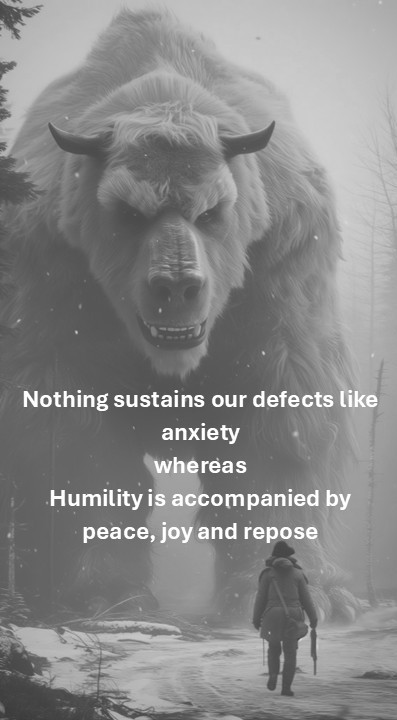
The contemplative traditions teach that thoughts and feelings are visitors, not identity. They arise, pass through, and dissolve. We suffer when we cling to them, fight them, or build an entire self around them.
The false self says:
“I am my fear.”
“I am my failure.”
“I am my shame.”
“I am what happened to me.”
But deeper awareness reveals something else:
you are the awareness capable of witnessing all of it.
This is why mindfulness, contemplation, and prayer matter so deeply in the modern world. We live in a culture constantly pulling us outward — toward distraction, reaction, outrage, comparison, and performance. We become fragmented because we lose the ability to sit quietly with ourselves without immediately escaping into stimulation.
Yet healing often begins the moment we stop running.
Not every thought requires belief.
Not every emotion requires action.
Not every wound requires shame.
Sometimes the spiritual path is simply learning to remain present long enough for truth to unfold gently within us.
As I’ve written elsewhere:
“Silence isn’t the absence of noise but the absence of selfishness surrounded by the now, give yourself fully to sacred moment.”
The non-dual worldview does not erase distinctions. It transcends fragmentation.
We begin integrating:
- reason and emotion,
- mind and body,
- contemplation and action,
- faith and science,
- self-awareness and self-compassion.
And eventually we discover something profoundly healing:
Thoughts can pass through us.
Feelings can pass through us.
Fear can pass through us.
Grief can pass through us.
Without destroying us.
The goal is not emotional perfection.
The goal is loving awareness.
To arrive at a place where the nervous system, the mind, and the soul slowly learn:
“Yes. Everything is okay.”
Not because life is painless.
Not because suffering disappears.
But because we no longer abandon ourselves inside the experience.
And perhaps that is one of the deepest forms of spiritual awakening:
to stop fighting your humanity long enough to discover that grace was already holding it all along.
Practice: Let the Feeling Speak
Today, practice observing your inner world without judgment.
- When a strong emotion arises, pause before reacting.
- Ask gently: “What is this revealing about me to myself?”
- Notice whether the feeling points toward a wound, fear, longing, or unmet need.
- Breathe slowly and allow the emotion to exist without suppressing or dramatizing it.
- Repeat quietly: “This feeling is passing through me. It is not all of me.”
- Spend ten minutes in silence without distraction or analysis.
- End by placing your hand over your heart and saying: “I do not need to fear my own experience.”
Healing begins when awareness becomes compassionate rather than condemning.